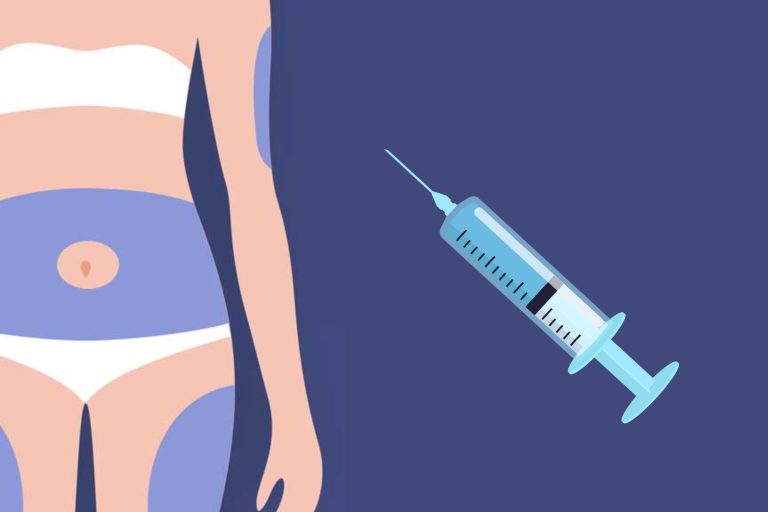
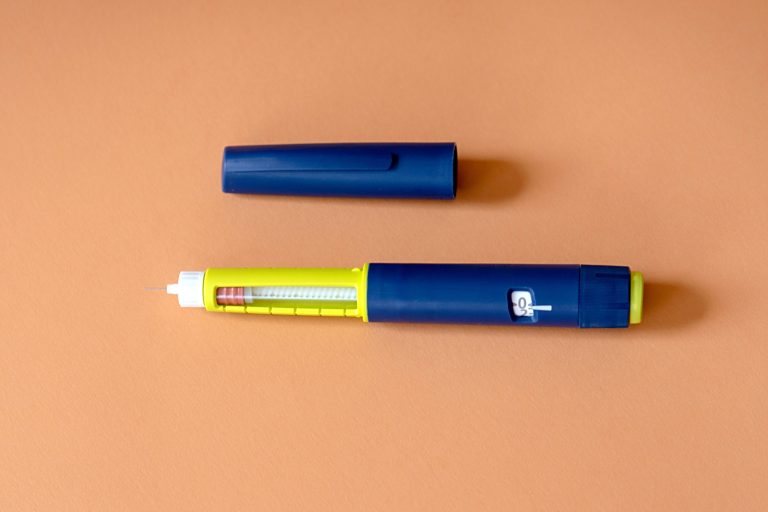
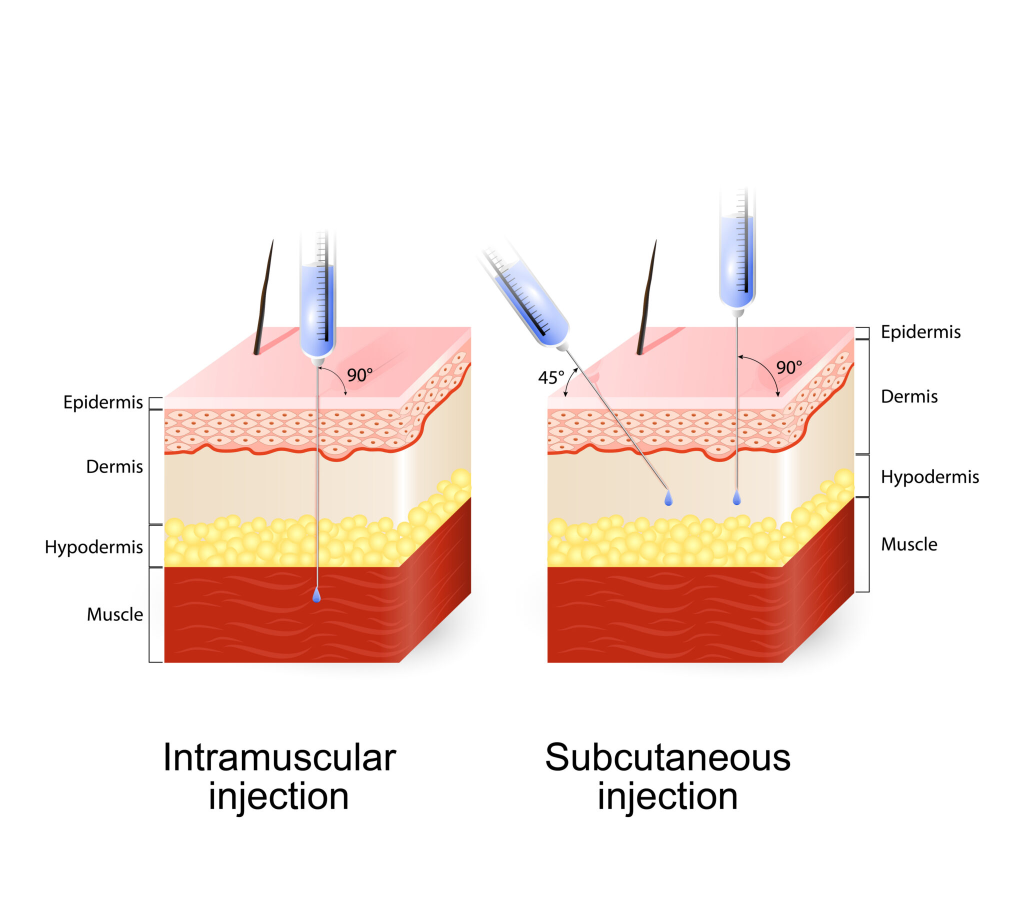
The needle is bigger and the injection site is harder to reach than subcutaneous injections. Intramuscular injections are used for medications that are best absorbed in the muscle. The muscle is located beneath the skin and fatty subcutaneous layer. A larger needle is needed to reach the muscle and administer the medication in the correct place.
Caution needs to be taken to avoid injecting directly into nerves, blood vessels, joints or bone.
Rotate where you give injections. Scar tissue can accumulate and negatively affect the potency of the medication if you give an injection in the same place every day or even every week.
Where Can I Administer a Intramuscular Shot?
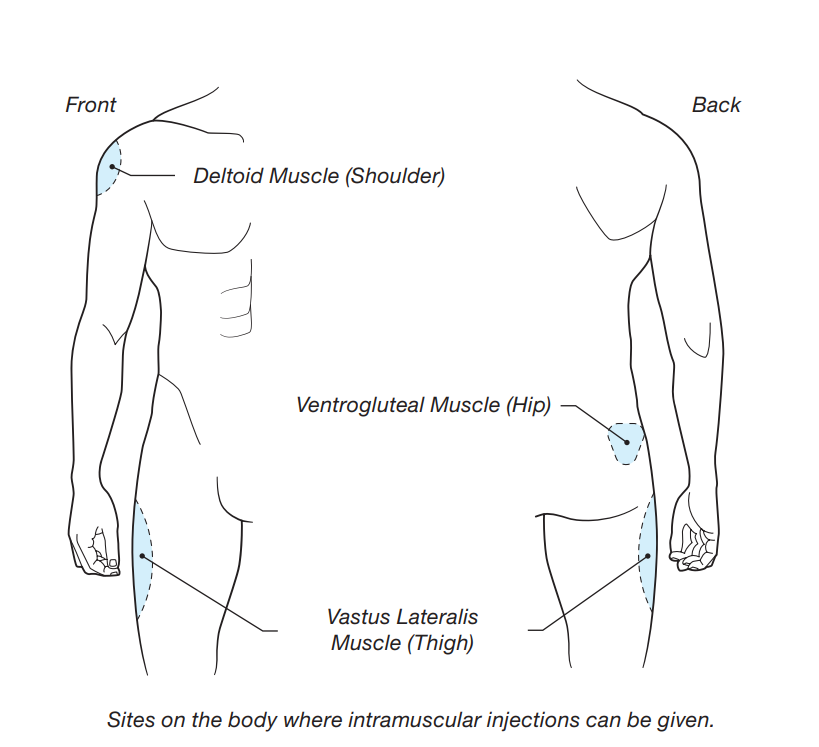
Deltoid Muscle (Shoulder)
This site is recommended if someone else will give you the shot. You can sit, stand or lie down to receive the shot. Imagine an upside-down triangle on the side of your upper arm. To find the base of the triangle, feel for the bone that goes across the top of the upper arm. This bone is called the acromion process, and the bottom of this bone will be the base line of the triangle.
You can sit, stand or lie down to receive the shot. Imagine an upside-down triangle on the side of your upper arm. To find the base of the triangle, feel for the bone that goes across the top of the upper arm. This bone is called the acromion process, and the bottom of this bone will be the base line of the triangle.
Ventrogluteal Muscle (Hip)
The hip has good bone landmarks and poses very little danger of hitting blood vessels or nerves.
Place your thumb at the base of your tailbone and bring it straight across midway to your hip.
Put your index finger about 2 inches (5 cm) below the ridge of your hip bone. The V-shaped area between your thumb and index finger is the ventrogluteal muscle.
Vastus Lateralis Muscle (Thigh)
This is a recommended site for self-injections because it is easy to see
and access.
To find this muscle, divide your top thigh area into three equal parts – top (near your hip), middle, and bottom (near your knee).
Put your thumb in the middle of the top of the thigh and your fingers along the side. This is the correct muscle location.
Notes
Depress and pull the skin taut with your free hand. Keep holding the skin with your fingers a little to the side of where you plan to insert the needle.
Use your wrist to insert the needle at a 90-degree angle (straight in). The action is like shooting a dart. Do not slowly push the needle in. Do not thrust the needle as this can cause bruising. The needle is sharp, and it will go through the skin easily when your wrist action is correct.
Let go of the skin. As you let go of the skin, hold the syringe so it stays pointed straight in.
Pull back on the plunger just a little to make sure you aren’t in a blood vessel. Note: If blood enters the syringe, you may have hit a blood vessel. Remove the needle and dispose of both the syringe and the medicine. Repeat the process of cleaning and filling a new syringe. When you administer the injection again, select a new injection site.
Push down firmly on the plunger to inject the medication into the body. Some medications may sting slightly upon injection.
Pull the needle out quickly once all the medication is injected, at the same angle it went in.
Dispose of the syringe and needle in a sharps container.